Home › Transport › External transport manager records
What an external transport manager should record (and why)
As an external transport manager you're named on someone else's operator licence. If that operator ends up in front of a traffic commissioner, your own repute is on the line too. The question you'll be asked is simple: can you prove you were actually managing their transport?
 EXTERNAL TRANSPORT MANAGERS
The short version
- The law expects you to exercise continuous and effective management. Being a name on the licence isn't enough.
- As an external TM you need a written contract with each operator, and can act for no more than 4 operators and 50 vehicles in total.
- Keep a record of what you did, when, and what you told the operator: your hours, visits, meetings, checks, advice and follow-ups.
- If the operator ignores your advice, put it in writing. SD3 says that's the first step.
1. Why records matter so much for external TMs
An internal transport manager is in the building every day, so it's easy to show they're involved. An external TM might be on site a few hours a week. When something goes wrong, such as a prohibition, a run of drivers' hours offences or a failed maintenance investigation, the traffic commissioner will want to know whether you were genuinely in control or a "transport manager in name only".
Without records, it's your word against the evidence of what went wrong. With them, you can show exactly what you checked, what you found, what you advised and when.
2. Your contract and the 4/50 limit
- A written contract with each operator, setting out your duties and the time you'll spend. Keep the signed copy.
- No more than 4 operators and 50 vehicles in total across all the licences you're named on as an external TM.
- Keep a simple list of each operator: licence number, vehicles and trailers authorised, your contracted hours, and when the contract started.
3. Your hours
SD3 gives indicative weekly hours by fleet size as a starting point. For example, 2 to 4 hours a week for 1 or 2 vehicles, rising to 30 hours or more for 30 to 50 vehicles. They're not fixed rules, and a commissioner may expect more for things like several operating centres, trailers or a poor compliance history.
Record every block of time you spend on each operator, on site or remote, with what you did. That's your answer to "how much time do you actually give this operator?"
4. Site visits and checks
For each visit to an operating centre, note the date, how long you were there, and what you checked. A good routine covers six checks:
- Defect reportsCompleted, returned and acted on
- Safety inspectionsPMI records and the maintenance planner
- TachographsDownloads done and analysed
- Licences and CPCDriver checks up to date
- Vehicle conditionA walk-round look at the fleet
- Licence discsO-licence discs and documents
Then write down what you found and what you asked to be done, with a due date.
5. Driver meetings and debriefs
Inductions, toolbox talks, infringement debriefs and retraining all count. For each one record the driver, the topic, what was agreed, and any follow-up date. Get the driver to sign your note. It shows the conversation happened and that they understood.
6. Director meetings and advice in writing
This is where external TMs are most exposed. If you raise a problem verbally and nothing happens, there's no evidence you ever raised it.
- After each meeting with the operator's directors, confirm your advice in writing. An email is fine.
- Keep a log of concerns you've raised: the issue, the risk, your advice, the date you put it in writing, when you expected a response, and what happened.
- If you're overridden, SD3 says you should first notify the operator in writing, then take further appropriate action if it isn't resolved.
7. Audits, actions and your own CPD
- Audits: periodically review each compliance system (maintenance, defect reporting, drivers' hours, licences and CPC, working time, licence conditions) and record the result.
- Actions: every action raised from a visit, meeting or audit, with an owner and due date, and when it was closed.
- Your CPD: keep your own refresher training and certificates. Commissioners can ask how you keep your knowledge current.
8. The operator's records you oversee
GOV.UK lists the records a transport manager is responsible for making sure are kept. You don't have to hold them all yourself, but you should know they exist and check them:
| Record | Keep for |
|---|---|
| Vehicle maintenance records (inspections, defects, repairs) | At least 15 months |
| Drivers' hours records | At least 12 months |
| Working time records | At least 24 months |
| Driver card downloads | At least every 28 days (more on downloads) |
| Vehicle unit downloads | At least every 90 days |
| Maintenance planner | Inspection dates set at least 6 months ahead, including MOT and calibration dates |
9. Keeping it ready for a public inquiry
If you're ever called to a public inquiry, you'll need to put your evidence together quickly. Make that easy now:
- give each document a reference number (contracts, visit notes, emails, audit reports)
- keep an index of what each reference is and where it's stored
- store emails confirming your advice somewhere you can find them by operator and date
If you're called to a public inquiry, consider getting advice from a specialist transport solicitor. Good records help, but they don't guarantee any outcome.
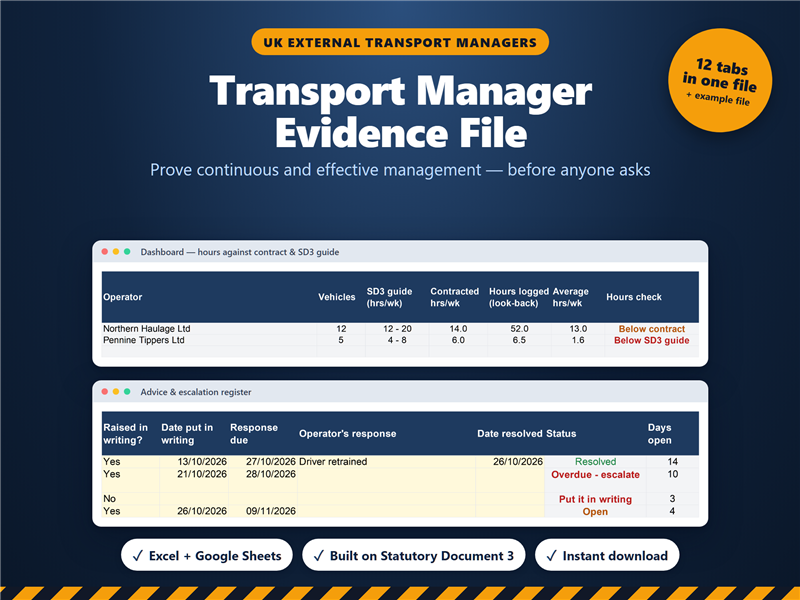
Our Transport Manager Evidence File has a tab for each record in this guide: operators and the 4/50 check, time log against the SD3 hours, site visits, driver and director meetings, an escalation log that prompts you to put advice in writing, actions, audits, CPD and an evidence index. Excel and Google Sheets.
See the template on Etsy